Antifreeze Amnesia: The Coolant Neglect That's Quietly Destroying American Engines
Ask most drivers when they last had their coolant serviced, and you will likely be met with a long pause. Unlike oil changes, which have been drilled into American car culture for decades, coolant flushes occupy a strange blind spot in the average maintenance routine. They are not discussed at the gas station. They rarely appear on the quick-lube shop's reminder sticker. And yet, the fluid circulating through your engine's cooling system is doing some of the most consequential work of any liquid in your vehicle.
Ignoring it has a price — and that price tends to arrive without warning.
What Coolant Actually Does (And Why It's More Complex Than You Think)
The term "antifreeze" is technically accurate but incomplete. Yes, coolant lowers the freezing point of the liquid in your cooling system, which matters enormously in states like Minnesota, Wisconsin, or Michigan during winter. But it also raises the boiling point, preventing your engine from overheating during a July afternoon in Phoenix or Atlanta. More importantly, coolant contains a carefully formulated package of corrosion inhibitors, scale preventers, and lubricants that protect the metal surfaces inside your engine, radiator, water pump, and heater core.
Those inhibitors are the real story. They are what separates functional coolant from a liability.
Over time — through heat cycles, contamination, and simple chemical aging — those protective additives deplete. The fluid becomes acidic. And acidic coolant does not just fail to protect your engine's internal surfaces; it actively attacks them. Aluminum components are particularly vulnerable, and modern engines use aluminum extensively. The result can be pitting in the cylinder head, erosion of the water pump impeller, and the formation of silicate deposits that restrict coolant flow.
The Multiplying Problem of Coolant Types
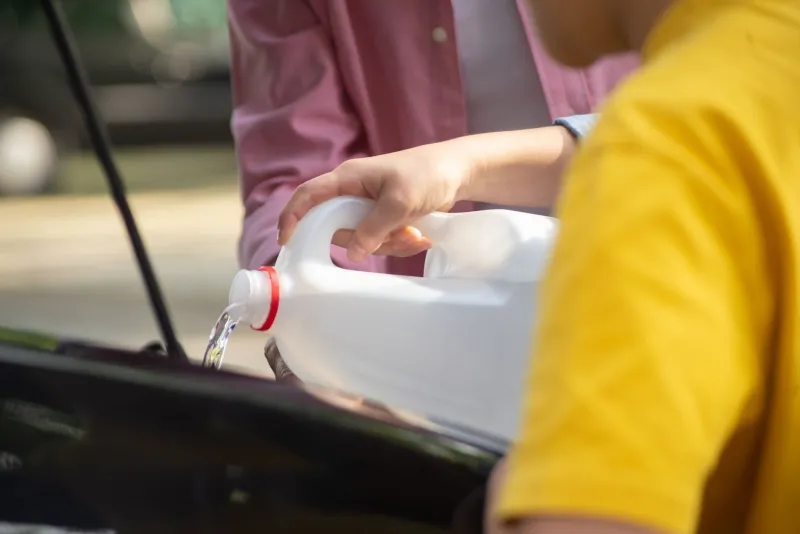
Not all coolants are interchangeable, and this is where many well-intentioned DIY top-offs go wrong. The three primary coolant chemistries currently in use in the United States each serve different vehicle platforms:
- IAT (Inorganic Additive Technology): The traditional green coolant. Largely phased out of modern vehicles but still found in older domestic cars and trucks. Requires replacement every two years or 30,000 miles.
- OAT (Organic Acid Technology): Common in GM vehicles and many European imports. Typically orange, red, or yellow depending on the manufacturer. Rated for longer service intervals but still subject to additive depletion.
- HOAT (Hybrid OAT): Used widely by Ford, Chrysler, and many Asian manufacturers. Often gold or yellow in color. Blends organic and inorganic inhibitor packages.
Mixing these chemistries — even when both fluids are "antifreeze" — can cause the inhibitor packages to react against one another, forming a gel-like sludge that reduces heat transfer and clogs narrow passages. If you have ever added a bottle of green coolant to a reservoir that called for orange, you may have already created a problem without realizing it.
The Gap Between What Manufacturers Recommend and What Drivers Do
Most manufacturer maintenance schedules recommend a coolant flush somewhere between 30,000 and 100,000 miles depending on the vehicle and coolant type. Many modern vehicles with long-life coolants suggest intervals of five years or 150,000 miles. Those numbers sound reassuring — until you consider that the average American keeps a vehicle for approximately 8.4 years according to industry data, and coolant service rarely makes it onto the priority list during that ownership window.
The result is that a substantial portion of vehicles on American roads are operating with coolant that has long since exhausted its protective chemistry. The fluid may look clean. The reservoir may show an adequate level. But a simple pH test strip — available at any auto parts store — will often tell a different story.
A professional coolant service, which typically includes draining the old fluid, flushing the system to remove contaminants, and refilling with the correct coolant mixed to the proper concentration, generally costs between $100 and $175 at a reputable shop. That figure tends to produce sticker shock in drivers who have been paying $50 for oil changes. It should not. The math is straightforward.
What Deferred Coolant Maintenance Actually Costs
When corrosive coolant is allowed to work against your engine's internals unchecked, the damage it causes is cumulative and often invisible until a threshold is crossed. The most common failure points include:
Water pump failure: The pump's impeller and shaft seals are in constant contact with coolant. Acidic fluid accelerates seal degradation and can erode the impeller itself. Water pump replacement on a modern vehicle typically runs $300 to $750 depending on accessibility.
Radiator damage: Coolant scale and corrosion deposits restrict flow and reduce the radiator's heat-exchange efficiency. A radiator replacement can range from $400 to over $900 for many domestic and import vehicles.
Head gasket compromise: Sustained overheating events — which become more likely as cooling system efficiency degrades — are among the leading causes of head gasket failure. Head gasket repair is one of the most labor-intensive services in automotive work, with costs regularly exceeding $1,500 and often approaching $3,000 or more on V6 and V8 engines.
Heater core blockage: The heater core is essentially a small radiator inside your dashboard. Silicate deposits from degraded coolant are a primary cause of heater core blockages and failures, which require dashboard disassembly to address. Labor alone on a heater core replacement can exceed $800 on many vehicles.
None of these outcomes are inevitable. They are the downstream consequence of a maintenance step that most drivers simply never prioritize.
How to Know When Your Coolant Needs Attention
Beyond following your manufacturer's mileage interval, there are several indicators that your cooling system deserves a professional inspection:
- Discoloration: Coolant that appears brown, rusty, or cloudy rather than its original color has likely been compromised.
- Visible deposits: Crusty white or rust-colored buildup around the radiator cap or overflow reservoir suggests contamination.
- Unusual odor: A sweet smell inside the cabin can indicate a heater core leak; a sweet smell under the hood may signal an external coolant leak.
- Temperature gauge behavior: Any tendency for the temperature gauge to creep higher than normal, even briefly, warrants investigation.
- Low reservoir level: Coolant systems are closed. A consistently dropping level means fluid is going somewhere — and that somewhere is worth finding.
The Right Approach to Coolant Service
A professional coolant flush is not simply a drain-and-fill. A thorough service involves pressure-testing the system for leaks, inspecting the radiator cap's pressure rating, examining hoses for internal deterioration, and verifying that the new coolant mixture achieves the correct freeze and boil protection for your climate. In northern states, a mixture that protects to -34°F is standard. In southern states, protection to -20°F is often sufficient, but the corrosion inhibitor chemistry matters equally regardless of geography.
At Carshen Garage, coolant service is approached as a system evaluation, not merely a fluid swap. The condition of hoses, clamps, the thermostat, and the radiator cap all factor into a complete assessment — because addressing one failing component while ignoring adjacent wear is how drivers end up back in the shop six months later.
The cooling system is not glamorous. It does not generate the conversation that tire performance or brake feel does. But it is one of the few systems in your vehicle where deferred maintenance carries a near-certain penalty. The question is simply how long before that penalty is collected.