The $40 Part That's Destroying Your $200 Belt: What Shops Aren't Telling You About Idler Pulleys
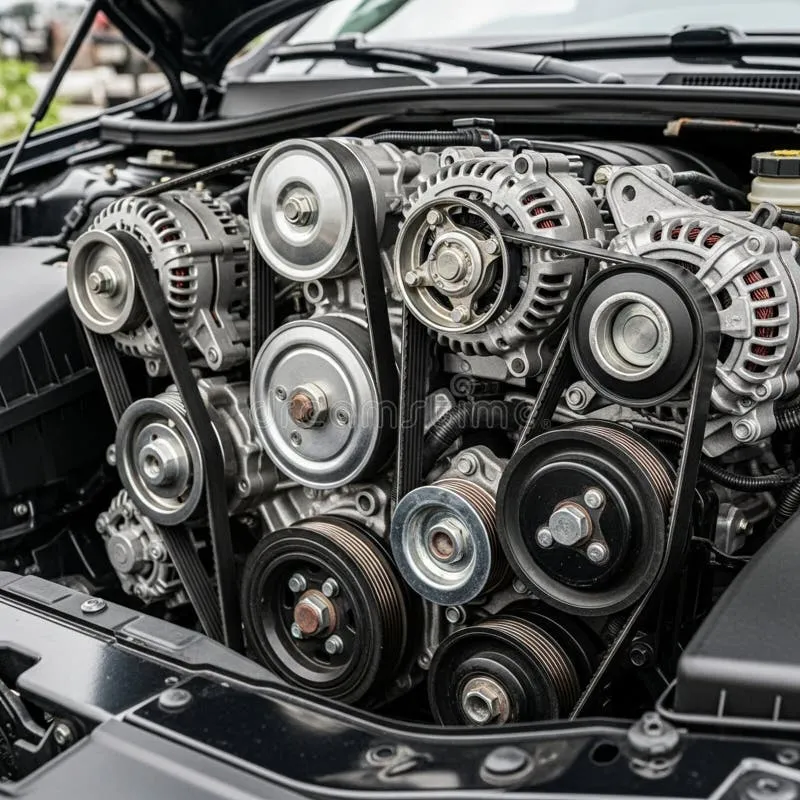
Photo: idler pulley serpentine belt engine bay close up, via thumbs.dreamstime.com
Most vehicle owners have heard of the serpentine belt. It's the long, ribbed loop that winds through your engine bay, driving everything from the alternator to the power steering pump to the air conditioning compressor. When it snaps, the vehicle stops functioning almost immediately. It's a part that commands attention — and commands a service ticket.
The idler pulley, by contrast, commands almost nothing. It sits quietly on its bracket, spinning without driving any accessory, doing nothing more than guiding the belt along its path and maintaining proper tension. No one writes articles about idler pulleys. No one sells maintenance packages around them. And in most independent shops and dealerships across the country, no one inspects them unless a customer specifically asks — or unless something has already gone wrong.
That oversight is costing American drivers hundreds of dollars at a time, often more than once on the same vehicle.
What an Idler Pulley Actually Does
To understand why idler pulley failure matters, it helps to understand what the component is designed to accomplish. The serpentine belt doesn't travel in a straight line. It wraps around multiple pulleys at different positions and angles throughout the engine bay, and it needs to maintain consistent contact and tension across all of them to function correctly.
Idler pulleys are the non-driven wheels in that system. They don't connect to any accessory. Their job is purely mechanical: redirect the belt's path, keep it aligned, and ensure it runs smoothly over every component it serves. Most vehicles have at least one idler pulley, and many have two or more.
Each idler pulley contains a sealed bearing at its center. That bearing is what allows the pulley to spin freely as the belt moves across it. And that bearing is exactly what fails.
Why the Bearing Fails Before the Belt Does
A serpentine belt is a flexible rubber component designed to absorb stress, flex repeatedly, and operate across a wide range of temperatures. It's engineered for wear. The bearing inside an idler pulley, however, is a precision mechanical part sealed with grease and protected by a thin shield. Over time, heat cycles degrade that grease. Road vibration introduces micro-movement that accelerates wear. Moisture infiltration — common in climates across the Midwest, Northeast, and Pacific Northwest — corrodes the bearing races.
The result is a bearing that begins to develop play long before the belt shows any visible deterioration. As that play increases, the pulley starts to wobble on its axis. That wobble is subtle at first — invisible to the naked eye during a routine visual inspection. But it places irregular lateral stress on the belt with every revolution of the engine.
A belt experiencing that kind of uneven loading doesn't wear uniformly. It develops edge fraying, rib cracking, and glazing on one side faster than the other. Eventually, the belt fails prematurely — often well before its expected service interval — and the shop replaces it without ever identifying the underlying cause. Weeks or months later, the new belt begins showing the same wear pattern. The cycle repeats.
The Warning Signs Most Drivers Dismiss
Idler pulley wear does produce symptoms. The problem is that those symptoms are easy to misattribute or simply ignore until they escalate.
A high-pitched squealing or chirping noise from the engine bay, particularly at startup or during acceleration, is one of the earliest signs. Many drivers assume this is a belt issue and apply belt dressing — a temporary fix that masks the symptom without addressing the source.
A subtle grinding or rumbling sound that increases with engine RPM often indicates a bearing that has moved beyond early wear into active degradation. At this stage, the bearing may have developed roughness or flat spots that produce audible friction.
Visible wobble on the pulley itself can sometimes be detected during a careful visual inspection with the engine running. If the pulley appears to oscillate or vibrate rather than spinning smoothly, the bearing has significant play and replacement is overdue.
Belt wear that appears one-sided or uneven — fraying along one edge while the opposite edge looks relatively intact — is a strong indicator that a misaligned or wobbling pulley is directing stress unevenly across the belt's width.
If any of these symptoms are present, the idler pulley should be inspected immediately. Waiting until the bearing seizes entirely can cause the belt to be thrown off the engine at highway speed, disabling all belt-driven systems simultaneously.
Why Shops Consistently Miss This
The inspection failure isn't usually a matter of incompetence. It's a matter of incentive structure and time constraints.
A standard oil change or multi-point inspection allocates a limited amount of time to each vehicle. Technicians visually scan components, check fluid levels, and note obvious wear. An idler pulley bearing that is failing internally but hasn't yet produced audible noise won't flag during that kind of inspection. There's no warning light for it. There's no fluid to check. There's no obvious visual deterioration on the pulley's exterior.
Additionally, the idler pulley is not a high-margin repair. At $30 to $50 for the part and under an hour of labor, it doesn't generate the kind of revenue that motivates proactive upselling. Shops are far more likely to recommend a new serpentine belt — a more visible and more expensive item — than to suggest replacing the smaller, less familiar component sitting adjacent to it.
The practical consequence is that idler pulleys are almost universally replaced reactively rather than preventively.
The Replacement Logic That Actually Makes Financial Sense
Here is the straightforward arithmetic that shops rarely walk customers through: when a serpentine belt is replaced, the idler pulley should be replaced at the same time.
The labor involved in accessing the serpentine belt system is the same whether or not the idler pulley is replaced during that visit. The additional cost of the pulley itself is minimal. By contrast, if the idler pulley fails after a new belt has been installed, the customer pays full labor costs again to access the same system — plus the cost of a second belt that was damaged by the failing pulley.
Most manufacturers recommend serpentine belt replacement somewhere between 60,000 and 100,000 miles depending on the vehicle. Idler pulley bearings, operating in the same heat and vibration environment, have a similar or shorter service life. Treating them as a paired replacement item is not unnecessary upselling — it is sound mechanical logic.
When scheduling serpentine belt service, ask your technician specifically about the condition of the idler pulley and tensioner pulley. Request that both be inspected and, if the vehicle has significant mileage, replaced as a precaution. The incremental cost is modest. The protection it provides against premature belt failure is substantial.
A Small Part With Outsized Consequences
The idler pulley will never be the most discussed component in your engine bay. It doesn't carry the name recognition of the alternator or the urgency of the timing belt. But its condition has a direct and measurable impact on the lifespan of every other part in the accessory drive system.
At Carshen Garage, thorough diagnostics mean looking beyond the obvious. A complete serpentine belt inspection includes every pulley in the system — not just the belt itself. That's not a premium service. That's what responsible vehicle maintenance looks like.