The Part That Fails Before the Belt Does: What Your Mechanic Should Be Telling You About Tensioners
When most vehicle owners think about serpentine belt maintenance, the mental image is straightforward: a long rubber belt winding through a series of pulleys, eventually wearing down and needing replacement. That picture is accurate as far as it goes. But it leaves out a critical component — one that routinely fails before the belt itself and one that mechanics frequently overlook until it causes a far more expensive problem.
The automatic belt tensioner is not a glamorous part. It does not have a memorable name. It rarely appears in the maintenance schedule printed in your owner's manual. Yet it is the single component responsible for maintaining the precise load on your serpentine belt at all times, under all engine conditions. When it begins to fail, the consequences can move fast — and they almost never announce themselves clearly.
What a Belt Tensioner Actually Does
The automatic tensioner is a spring-loaded arm mounted to the engine block, typically with a smooth idler pulley at its end. Its job is to apply continuous, calibrated pressure against the serpentine belt, keeping it tight enough to drive every accessory system — the alternator, power steering pump, air conditioning compressor, and water pump — without slipping, while also absorbing the minor fluctuations in belt tension that occur as those systems cycle on and off.
The engineering is elegant in theory. In practice, the tensioner contains a coil spring and internal dampening mechanism that are both subject to fatigue, corrosion, and wear over years of continuous use. The pivot bearing on the arm itself is another failure point. Any one of these internal components can degrade well before the belt shows visible signs of cracking or fraying.
This is the core problem: a belt can look perfectly serviceable to the naked eye while the tensioner holding it in place is already compromised.
Why Tensioners Fail Before the Belt
The serpentine belt is a visible, tactile component. A technician can run a hand along it, look for glazing or cracks, and make a reasonably confident call about its condition. Tensioners offer no such convenience. Their internal spring tension cannot be assessed by sight alone, and the dampening mechanism — which prevents the arm from bouncing excessively under load — degrades internally in ways that leave no outward mark.
Heat is the primary accelerant. Tensioners live in the same engine bay environment as every other accessory component, cycling through extremes of temperature with every drive. The internal spring gradually loses its calibrated tension over time. In climates with pronounced seasonal swings — think the upper Midwest, the Mountain West, or New England — that thermal cycling is particularly aggressive.
Mileage compounds the issue. Most manufacturers design tensioners for a service life that roughly parallels the belt itself, somewhere in the 60,000 to 100,000 mile range. But that estimate assumes average operating conditions. Stop-and-go driving in urban areas, extended idling, and heavy accessory loads from air conditioning in southern states can all accelerate internal wear significantly.
The Symptoms That Are Easy to Misread
A failing tensioner rarely produces a single, unmistakable symptom. Instead, it tends to generate a cluster of subtle signals that are easy to attribute to other causes.
Belt squeal that comes and goes. Intermittent squealing is one of the earliest indicators of tensioner fatigue. As the internal spring loses its calibrated load, the belt can momentarily slip on accessory pulleys, particularly during cold starts or when the air conditioning compressor engages. Many drivers — and some technicians — assume this noise means the belt itself needs replacement. Replacing the belt without addressing the tensioner simply resets the clock on the same problem.
Visible belt oscillation. A belt that appears to flutter or bounce rhythmically at idle is demonstrating what engineers call tensioner arm oscillation. The dampening mechanism inside the tensioner is supposed to absorb these movements. When it fails, the arm swings more freely, and that motion becomes visible. This symptom is worth taking seriously — it indicates the tensioner is no longer controlling belt dynamics properly.
Accessory system irregularities. Because the serpentine belt drives the alternator and water pump, a tensioner that allows intermittent belt slip can produce symptoms that appear to originate in those systems. Voltage fluctuations, minor overheating episodes, and power steering hesitation can all trace back to a tensioner that is no longer maintaining consistent belt load. Chasing those symptoms without inspecting the tensioner leads to misdiagnosis and unnecessary parts replacement.
A grinding or rattling noise from the front of the engine. When the tensioner's pivot bearing begins to fail, it often produces a grinding or rattling sound that can be difficult to localize. This symptom tends to appear later in the failure progression, and by the time it is audible, the bearing may be close to seizing entirely.
Why It Gets Missed During Inspections
Routine inspections at quick-service facilities are designed around speed. A technician performing a multi-point inspection has limited time and is looking primarily for the most obvious indicators of wear. The belt gets a visual check. The tensioner, if it is examined at all, typically receives a brief manual deflection test — a technician pushes on the arm to see if it moves. That test can confirm gross failure but will not detect a spring that has lost 30 percent of its calibrated tension or a dampener that is beginning to break down.
The deeper issue is that tensioners are not consistently included in standard maintenance recommendations. Manufacturers list them as inspect-and-replace-as-needed components rather than scheduled service items, which means they fall into a gray area where accountability is diffuse. No one is specifically responsible for catching a tensioner that is quietly failing.
The Right Way to Handle Tensioner Service
The most cost-effective approach is straightforward: replace the tensioner at the same time the serpentine belt is replaced. The labor overlap is significant — accessing the tensioner requires the same disassembly as belt replacement — and the parts cost is modest relative to what a tensioner failure can trigger downstream.
A seized tensioner arm or a failed pivot bearing can cause the belt to depart the pulley system entirely while the engine is running. When that happens, the water pump stops, the alternator stops charging, and power steering assist is lost simultaneously. In the best case, the driver pulls over quickly and the repair is limited to a tow and a belt and tensioner replacement. In worse cases, the engine overheats before the driver reacts, and the repair bill grows substantially.
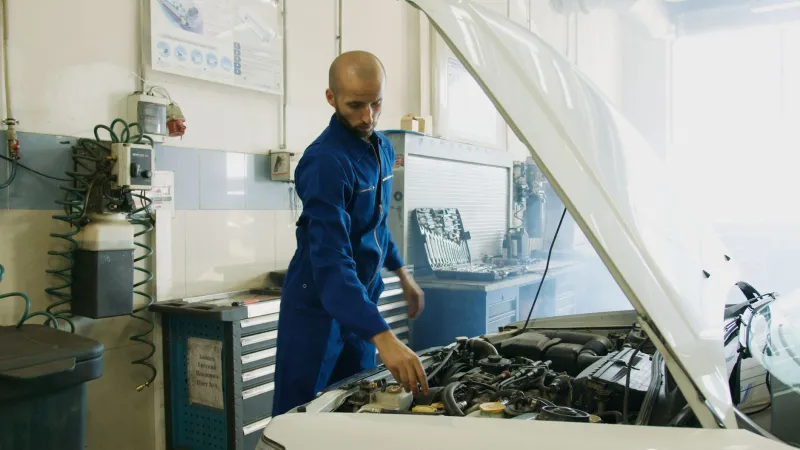
At Carshen Garage, when a serpentine belt service comes through the shop, the tensioner is inspected with proper tools — not just a quick visual — and its replacement is recommended based on actual condition and mileage, not assumptions. That approach costs a modest amount more than a belt-only swap. It reliably prevents the kind of failure that leaves a driver on the shoulder of an interstate with a phone call to make and an engine that may have already sustained heat damage.
The belt may be the part everyone talks about. But the tensioner is the part that decides how the story ends.