The Shoulder Season Blind Spot: Why Spring and Fall Are the Most Expensive Months to Skip Vehicle Service
The automotive maintenance industry has done an effective job communicating two seasonal service narratives: prepare your vehicle for winter, and check your cooling system before summer. These are sound recommendations. They are also incomplete ones.
The months surrounding those extremes — the March thaw after a northeastern winter, the October cooldown before the first frost — are when a significant share of preventable vehicle damage accumulates. Not because the weather is severe, but because owners are not paying attention. The shoulder seasons occupy a blind spot in most maintenance calendars, and the repair invoices that follow tend to arrive in the worst possible months.
What Spring Is Actually Doing to Your Vehicle
Winter road treatment in the United States involves millions of tons of road salt annually. States across the Midwest, Northeast, and Mountain West apply chloride-based deicers from November through March on a scale that the automotive industry has studied extensively and the general public largely underestimates.
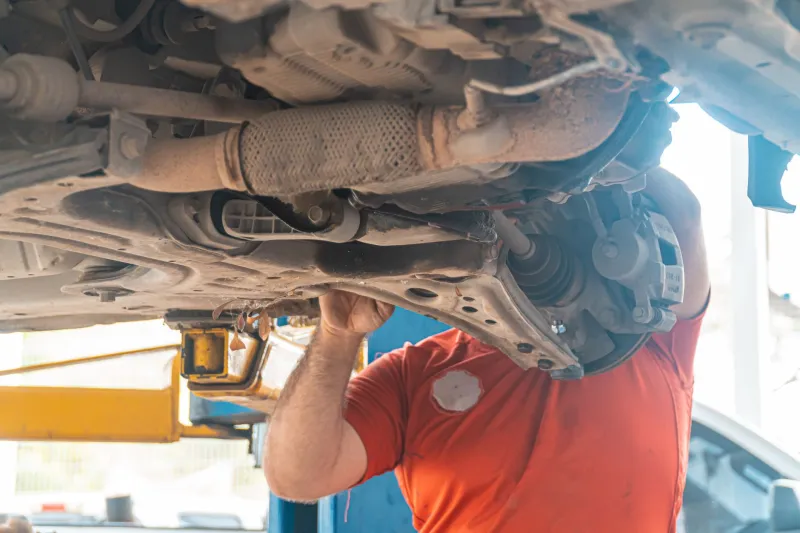
By the time spring arrives, the undercarriage of a vehicle that has been driven through treated roads carries a chemical residue that does not simply wash away with the first rain. Salt infiltrates brake hardware, suspension joints, wheel well liners, subframe mounting points, and exhaust hangers. When temperatures rise and moisture increases, that residue becomes an accelerant for corrosion.
Spring is not when rust begins. It is when rust that started in November becomes structurally relevant.
Brake System Vulnerability After Winter
Brake components are among the most corrosion-susceptible systems on any vehicle. Rotors, calipers, and brake hardware operate in direct contact with road spray throughout winter. By spring, surface rust on rotors — while visually normal — can indicate more serious concerns at the caliper slide pins, which must move freely for brake pads to release properly.
Seized caliper slide pins cause uneven pad wear, premature rotor scoring, and in advanced cases, a dragging brake that generates heat, reduces fuel economy, and can eventually warp the rotor entirely. A thorough spring brake inspection — not simply a visual check, but an assessment of caliper function, hardware condition, and brake fluid moisture content — addresses this before it compounds.
Brake fluid absorbs moisture over time. A winter's worth of thermal cycling and exposure accelerates that process. High moisture content in brake fluid lowers its boiling point, increasing the risk of vapor lock under hard braking. Spring is an appropriate time to test fluid moisture content with an inexpensive meter and replace it if necessary.
Suspension and Steering After the Freeze-Thaw Cycle
Frost heaves, pothole formation, and the general deterioration of road surfaces that accompanies spring thaw subject suspension components to impact loads that summer and fall roads rarely replicate. Ball joints, tie rod ends, sway bar links, and strut mounts absorb those loads continuously.
A spring suspension inspection should look specifically for boots that have cracked or torn during winter — allowing the grease inside to escape and contaminants to enter — and for any looseness in steering linkage components that may have developed during months of stressed operation. These are not dramatic failures. They are incremental ones, and they are far less expensive to address in April than after a summer of highway driving.
What Fall Is Quietly Setting Up Against You
Fall maintenance has a narrower window than spring. The transition from summer heat to winter cold happens faster in most US climates than the reverse, and several systems that were adequate in August become marginal by November.
The Cooling System's Seasonal Role Reversal
During summer, the cooling system's primary adversary is heat. During winter, its job shifts: coolant must protect the engine from freezing while maintaining its corrosion-inhibiting chemistry. Many drivers assume that because their coolant level reads correctly, the system is prepared for cold weather. Level and freeze protection are different measurements.
Coolant degrades chemically over time. The silicate and organic acid inhibitors that protect aluminum engine components, water pump impellers, and heater core passages deplete through normal operation. Degraded coolant with adequate freeze protection still allows internal corrosion to proceed unchecked. Fall is the correct time to test coolant chemistry — not just freeze point — and service the system if inhibitor levels are low.
A failed water pump or a developing leak that was manageable in summer becomes a roadside emergency when temperatures drop and the consequences of overheating occur faster. Inspecting hose condition, pressure testing the system, and confirming thermostat function in fall costs far less than a tow and an emergency repair in January.
Battery Testing Before Cold Reduces Its Capacity
A battery that starts a vehicle reliably in September may not do so in December. Cold temperatures reduce battery output — a fully charged battery at 0°F delivers roughly half the cranking power it produces at 80°F. A battery operating at 75 percent capacity in fall is effectively a marginal battery in winter.
Load-testing a battery in September or October, when the result reflects its true state rather than a cold-weather-suppressed reading, gives owners an accurate picture of replacement timing. Waiting until a no-start event in February eliminates that planning window entirely.
Wiper Blades and Lighting: The Details That Fail at the Worst Moment
Wiper blades degrade through UV exposure during summer. By fall, blades that appear structurally intact may streak, skip, or fail to clear the windshield in the first autumn rainstorm. Replacing them in October, rather than during a November downpour on an interstate, is a minor investment with straightforward safety implications.
Headlight output should also be assessed before daylight saving time ends and driving hours in darkness increase. Oxidized headlight lenses — common on vehicles more than five years old — can reduce usable light output by 50 percent or more. Professional lens restoration or replacement is a fall service that directly affects visibility during the months when it matters most.
Building a Shoulder Season Maintenance Calendar
The practical recommendation is not to add expensive service visits to an already full schedule. It is to redirect existing service timing to capture the shoulder season window.
For spring: schedule a brake inspection and fluid test, a suspension and steering check, a thorough undercarriage wash and inspection for corrosion, and a tire rotation that accounts for any irregular wear patterns that developed during winter.
For fall: schedule a cooling system chemistry test, a battery load test, wiper blade replacement, a lighting inspection, and a tire assessment before winter tires are needed — allowing time to order the correct fitment rather than rushing the decision.
None of these services is extraordinary. Together, they address the specific vulnerabilities that seasonal transitions create — and that most maintenance schedules, oriented around mileage intervals rather than calendar conditions, are not designed to capture.