Silent Failures: What Your Vehicle's Airbag System Isn't Telling You — And What It Costs When It Does

There is a particular kind of false confidence that comes with a dashboard free of warning lights. Most drivers interpret a dark airbag indicator as confirmation that their supplemental restraint system is functioning correctly. In many cases, that assumption holds. But in a meaningful number of vehicles on American roads today, it does not — and the gap between perceived safety and actual readiness is wider than most people realize.
Modern airbag systems are not simple. A typical mid-range sedan may contain anywhere from six to twelve airbags, each connected to a network of crash sensors, clockspring assemblies, impact discriminating algorithms, and a central airbag control module. Every one of those components can fail. Not all failures announce themselves.
How Airbag Sensors Actually Work — and Where They Break Down
Crash sensors are the first responders in any collision event. Positioned throughout the vehicle's frame, doors, and bumper structures, they measure deceleration rates and send real-time data to the airbag control module. When the module determines that a collision meets deployment thresholds, it triggers the inflators in milliseconds.
The problem begins with sensor degradation. Corrosion, vibration fatigue, moisture intrusion, and heat cycling — all routine byproducts of normal driving — can compromise a sensor's calibration over time. A sensor that reads slightly off-spec may still return no fault codes during a standard OBD-II scan. It simply becomes less reliable at the precise moment reliability matters most.
The airbag control module itself carries its own vulnerabilities. Many modules store crash data from prior events, including minor impacts that were never formally repaired. A module that has recorded a previous collision may be compromised in ways that prevent proper deployment in a subsequent crash — even if the airbag system appears fully intact from the outside.
Why Standard Diagnostics Often Miss the Real Problem
A routine diagnostic scan reads fault codes stored in the vehicle's onboard computer. This is useful for identifying active, confirmed failures. It is far less useful for identifying intermittent sensor drift, stored crash data within the SRS module, or clockspring degradation that has not yet crossed a hard fault threshold.
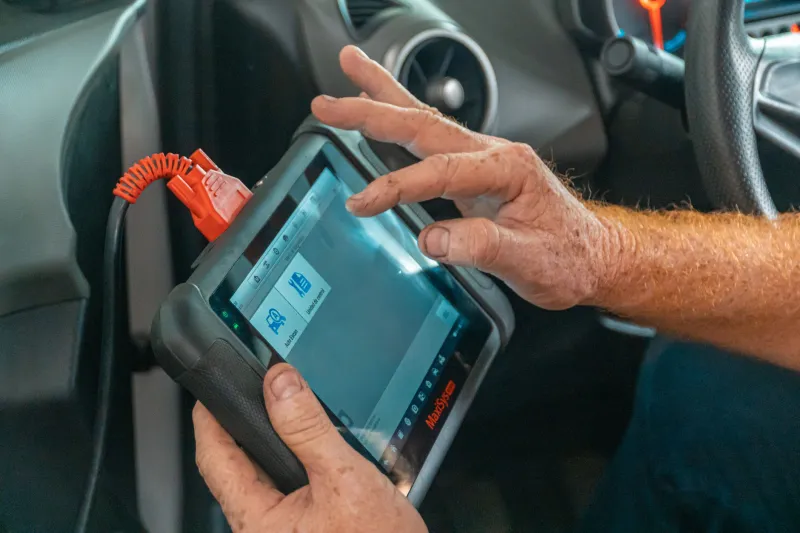
Diagnosing airbag system integrity properly requires dedicated SRS scanning tools, not the generic code readers available at most auto parts stores. Even among professional shops, the depth of SRS diagnostics varies considerably. A shop without the appropriate manufacturer-specific or advanced scan tool may clear a generic airbag code without ever identifying the underlying sensor or module issue that generated it.
This creates a diagnostic blind spot that is particularly dangerous because it is invisible. The light goes off. The customer drives away. The system remains compromised.
The Clockspring: A Component That Fails More Often Than You'd Expect
One of the most frequently overlooked airbag system components is the clockspring, sometimes called a spiral cable or clock spring assembly. Located within the steering column, it maintains continuous electrical contact between the steering wheel airbag and the vehicle's wiring harness while allowing the wheel to turn.
Clocksprings wear with every steering input. Over time — typically between 80,000 and 120,000 miles on many vehicles, though this varies — the coiled ribbon cable inside can crack or break. When a clockspring fails, the driver-side airbag loses its deployment circuit entirely. In some vehicles, this will trigger an airbag warning light immediately. In others, the failure is intermittent enough that it does not produce a consistent code.
Replacement costs for a clockspring typically range from $150 to $400 for the part, with labor adding another $100 to $250 depending on the vehicle. It is not an inexpensive repair, but it is considerably less expensive than the alternative.
What Repair Costs Actually Look Like
Airbag system repairs occupy a wide cost spectrum. A single faulty impact sensor may cost $200 to $500 to diagnose and replace. An airbag control module that has stored crash data and requires either replacement or professional recalibration can run $400 to $1,200 or more, depending on whether the module is sourced new, remanufactured, or salvaged and reprogrammed.
If airbags have deployed — in an accident or, in rare cases, due to a system malfunction — the costs escalate significantly. Replacing deployed airbags, the associated inflators, the SRS module, and all affected sensors in a moderately equipped sedan can easily exceed $3,000 to $5,000 in parts and labor alone. On newer vehicles with more complex restraint systems, that number climbs higher.
What Insurance May and May Not Cover
Many drivers assume their comprehensive or collision coverage will handle airbag system repairs after an accident. In most cases involving a legitimate collision claim, that assumption is correct — subject to your deductible. But there are important nuances.
If an airbag deploys due to a system malfunction rather than an actual collision, coverage becomes less straightforward. Spontaneous deployment events — which do occur, albeit infrequently — may be treated as mechanical failures rather than collision events, potentially falling outside standard collision coverage and into the territory of extended warranties or mechanical breakdown insurance, if you carry either.
Additionally, if your vehicle is declared a total loss after an accident, the insurer's settlement may not fully account for the cost of airbag-related repairs that would have been required even before the accident — particularly if pre-existing SRS faults existed.
The Practical Takeaway for Vehicle Owners
Airbag systems deserve periodic professional attention, not just reactive diagnosis when a warning light appears. If your vehicle is more than seven years old, has experienced any collision — however minor — or has accumulated significant mileage, a dedicated SRS system inspection using appropriate diagnostic equipment is worth scheduling.
At Carshen Garage, we approach safety system diagnostics with the same thoroughness we apply to mechanical repairs. A vehicle that looks safe from the outside and reads clean on a basic scan is not necessarily a vehicle with a fully functional restraint system. The difference matters most in the moments when there is no time left to find out.