Why a Single Diagnostic Code Can Send Your Repair Bill in the Wrong Direction
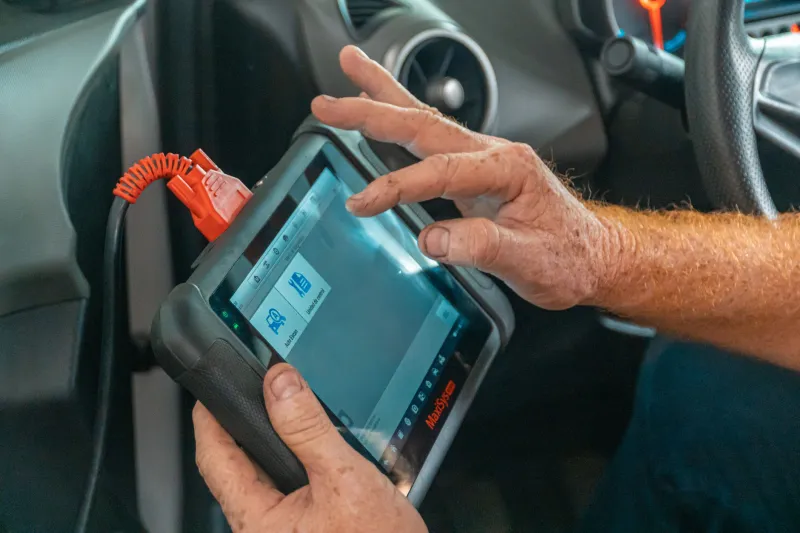
There is a moment familiar to anyone who has sat across from a service advisor holding a printed diagnostic report: the code appears, a part is named, and a price is quoted. The exchange feels clinical, authoritative, and complete. The trouble is that it frequently is not any of those things.
Diagnostic trouble codes — the alphanumeric strings your vehicle's onboard computer generates when it detects an anomaly — are among the most misunderstood tools in modern automotive repair. They are valuable. They are also routinely misapplied, leading to unnecessary parts replacements, recurring faults, and repair bills that solve the symptom while leaving the root cause intact.
What a Code Actually Tells You
The OBD-II system, which has been standard on US vehicles since 1996, continuously monitors hundreds of sensor inputs and operational parameters. When a reading falls outside its expected range, the system logs a diagnostic trouble code and, in many cases, illuminates the check engine light.
What the code records is a deviation — a measurement that crossed a threshold. It does not record why that deviation occurred. This distinction is not a technicality. It is the central challenge of modern vehicle diagnostics.
Consider P0401: Exhaust Gas Recirculation Flow Insufficient Detected. This code tells a technician that the EGR system is not moving exhaust gases in the volume the computer expects. It does not identify whether the EGR valve itself is the problem, whether a passage is carbon-fouled, whether the differential pressure feedback sensor has failed, or whether a vacuum line has cracked. All of those conditions produce the same code.
The P0401 Case Study
P0401 is one of the most instructive examples of diagnostic code misapplication in everyday shop work. It appears frequently on Toyota, Honda, Ford, and GM vehicles across multiple model years, and it generates a consistent pattern of premature parts replacement.
The EGR valve is the most commonly replaced component when P0401 appears. It is also, in many cases, not the failed component. On Toyota 4Runners and Tacomas from the late 1990s through the mid-2000s, P0401 is almost classically associated with carbon buildup in the EGR passages rather than valve failure. Replacing the valve without cleaning the passages returns the vehicle to the same restricted-flow condition within months.
On Ford vehicles using the DPFE (differential pressure feedback EGR) sensor design, P0401 frequently traces to a failed sensor rather than the valve itself. The DPFE sensor measures pressure differential across an orifice in the EGR tube. When the sensor fails — a common occurrence on many Ford applications — it reports incorrect flow data to the PCM, triggering the code. Replacing the EGR valve in this scenario accomplishes nothing. The sensor, which typically costs considerably less than the valve, is the actual repair.
Neither of these distinctions is obscure knowledge. Both are well-documented in factory service data and professional repair literature. Yet parts-based diagnosis — replacing the most obvious component associated with a code — remains widespread, particularly at high-volume shops where labor time is compressed.
Why This Pattern Persists
Several factors sustain parts-based diagnosis as a practice. First, scan tools have become inexpensive and widely accessible. The availability of the code, without the interpretive framework to contextualize it, creates an illusion of diagnostic completeness. Second, the economics of some shop models reward efficient throughput over thorough investigation. A technician who spends forty-five minutes tracing a vacuum leak earns less per hour than one who replaces a valve in twenty minutes — even if the latter repair proves incorrect.
Third, and perhaps most importantly, manufacturers design codes to meet regulatory requirements for emissions monitoring, not to provide technicians with precise fault identification. The code fulfills its legal function — flagging a system anomaly — without being engineered as a repair directive.
Root Cause Analysis in Practice
At Carshen Garage, a code like P0401 initiates an investigation rather than a work order. The diagnostic process begins with a review of freeze frame data — the operating conditions the vehicle's computer recorded at the moment the fault was logged. It continues with a physical inspection of the EGR system components: valve operation under commanded actuation, passage condition, sensor output under live data monitoring, and vacuum circuit integrity.
This approach takes longer than scanning and quoting a valve replacement. It also produces repairs that hold. When a customer returns to a shop with the same check engine light illuminated one week after a repair, the shop has not saved time — it has spent twice as much of it, along with the customer's money and trust.
Other Codes That Commonly Mislead
P0401 is not unique in its capacity to misdirect. P0420 — Catalyst System Efficiency Below Threshold — is frequently interpreted as a failed catalytic converter. In reality, it can originate from a failing upstream oxygen sensor, an exhaust leak near the sensor, or engine misfires that have thermally damaged the catalyst. Replacing a catalytic converter on a vehicle with an undiagnosed misfire produces a second destroyed catalyst within a predictable number of miles.
P0300 through P0308 — random and cylinder-specific misfire codes — similarly invite premature ignition component replacement when the actual cause may be a fuel delivery issue, a compression problem, or a failing crankshaft position sensor.
What to Ask Before Authorizing a Repair
Vehicle owners are not expected to perform their own diagnostic analysis. They are, however, entitled to ask a straightforward question before approving any repair based on a trouble code: how was the root cause confirmed?
A credible answer describes a process — specific tests performed, data reviewed, components inspected. An answer that amounts to "the code points to the [part]" is a signal that the diagnostic work may not be complete. Asking the question costs nothing. The repair it prevents might cost several hundred dollars.