Why a Fraction of an Inch in Your Wheel Alignment Is Costing You Far More Than You Realize
If you asked most drivers to describe a vehicle with an alignment problem, they would describe something obvious — a car that pulls aggressively to one side, a steering wheel cocked at an awkward angle, tires that look visibly worn. What they would not describe is their own vehicle, because alignment problems rarely present that dramatically. They present gradually, almost politely, while quietly dismantling components that cost hundreds or thousands of dollars to replace.
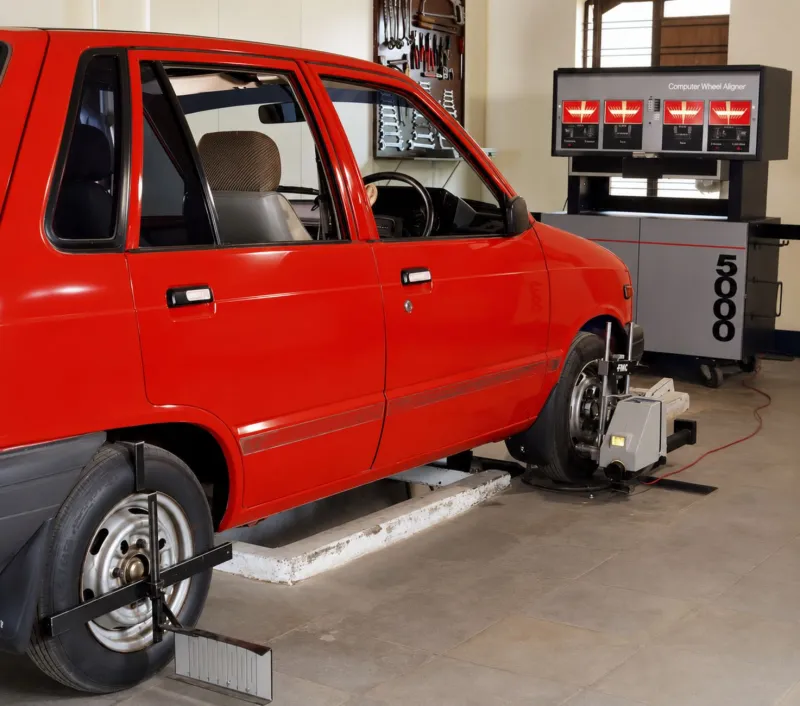
The diagnostic equipment used in modern alignment services measures angles in fractions of a degree. The acceptable tolerance windows are narrow by design, because engineers understand what happens when those tolerances are exceeded — even slightly — over the course of tens of thousands of miles. The cumulative effect is not minor. It is, in many cases, the difference between a routine maintenance visit and a repair estimate that requires a second look.
Understanding What Alignment Actually Measures
Wheel alignment is not a single measurement. It is a set of geometric angles — camber, caster, and toe — that describe the precise relationship between your tires and the road surface, and between your wheels and the vehicle's suspension geometry.
Toe describes whether the front edges of the tires point inward (toe-in) or outward (toe-out) relative to the vehicle's centerline. Even a small deviation from the specified toe angle causes the tire to scrub laterally against the road surface with every rotation. The tire is not rolling cleanly forward — it is being dragged at a slight angle, which generates heat and wears the tread unevenly at a rate that can reduce tire life by 30 percent or more.
Camber describes the vertical tilt of the tire when viewed from the front of the vehicle. Excessive negative camber (tops of the tires tilting inward) causes wear concentrated on the inner edge of the tread. Positive camber causes outer edge wear. Either condition accelerates tire degradation and compromises the contact patch — the portion of the tire actually touching the road — which directly affects braking performance and cornering stability.
Caster primarily affects steering stability and straight-line tracking. An incorrect caster angle does not produce the same visible tire wear patterns, but it influences how the vehicle responds to steering inputs and how aggressively it returns to center after a turn. Drivers with caster issues often describe a vague or unsettled steering feel that they attribute to tire pressure or road conditions rather than alignment.
How Misalignment Spreads Through the Vehicle
Alignment problems do not stay contained. This is the aspect that makes deferred alignment service genuinely costly rather than merely inconvenient.
Consider what happens when a vehicle operates with toe misalignment for six months. The tires wear unevenly and must be replaced prematurely — a cost of $600 to $1,200 depending on the vehicle. But the scrubbing force that wore those tires was also transmitted through the wheel, through the hub, and into the suspension components. Tie rod ends, ball joints, and control arm bushings are designed to operate within specific load parameters. Sustained lateral scrub forces exceed those parameters and accelerate wear in components that were otherwise functioning properly.
Once those suspension components develop play, the alignment cannot hold its specification — even after a fresh alignment service. The system has become self-reinforcing. Misalignment wears suspension parts, worn suspension parts prevent accurate alignment, and inaccurate alignment continues wearing tires and further stressing the suspension. The cascade does not stop until each compromised component is identified and replaced.
Beyond tires and suspension, misalignment measurably affects fuel economy. When tires are scrubbing against the road rather than rolling cleanly, the drivetrain must overcome additional resistance. Studies and real-world data consistently show that significant misalignment can reduce fuel efficiency by up to 10 percent. At current US fuel prices, that represents a meaningful ongoing cost for drivers who commute regularly.
Why Alignment Problems Go Undetected for So Long
The diagnostic challenge with alignment is that the human body is remarkably good at adapting to gradual change. A vehicle that develops alignment issues slowly — through the cumulative effect of potholes, curb strikes, or suspension wear — will not feel dramatically different from one week to the next. Drivers adapt to a subtle pull, a slightly off-center steering wheel, a vague sense that the car no longer feels quite as planted as it once did.
Shops also miss alignment issues more often than the industry acknowledges. A visual inspection of tires during an oil change may reveal uneven wear, but it does not quantify how far out of specification the alignment has drifted, and it does not diagnose which angle is responsible. Without placing the vehicle on an alignment rack with calibrated sensors, the specific nature of the problem remains a guess.
Additionally, alignment drift is not always caused by a single identifiable event. Many drivers assume they would know if they had hit something hard enough to knock their alignment out. In reality, the cumulative stress of ordinary driving on degraded road surfaces — particularly in regions with harsh winters and heavily potholed pavement — is sufficient to shift alignment angles outside of specification without any single dramatic impact.
Identifying the Early Indicators
While alignment problems are subtle, they are not invisible to an attentive driver. The following observations warrant a professional alignment check:
- Uneven tire wear. Examine the tread across the full width of each tire. Wear concentrated on one edge — inner or outer — or a feathered, sawtooth pattern across the tread blocks suggests misalignment. This inspection takes less than five minutes and should be part of any tire rotation service.
- Steering wheel position at rest. On a straight, level road, the steering wheel should sit within a few degrees of centered. A wheel that rests noticeably off-center is a reliable indicator of alignment deviation.
- Directional drift. On a straight, flat road with minimal crosswind, briefly release the steering wheel and observe whether the vehicle tracks straight or drifts toward one side. A pull that requires constant steering correction is not normal.
- Steering feel changes. Vagueness, looseness, or a sense that the vehicle wanders rather than tracks precisely are often early indicators of alignment-related suspension wear.
The Real-World Cost Comparison
A professional four-wheel alignment check at a reputable shop typically costs between $80 and $150. If adjustment is required, the service itself generally falls in the $150 to $200 range for most passenger vehicles. This is a fixed, predictable cost that can be budgeted and scheduled.
The alternative — deferring that service until symptoms become impossible to ignore — produces a very different cost structure. A set of prematurely worn tires: $600 to $1,200. Tie rod end replacement: $150 to $400 per side. Ball joint replacement: $200 to $500 per side. Control arm replacement, if bushings have deteriorated to the point that the arm itself is compromised: $400 to $900 per side. A full suspension overhaul on a vehicle that has been operated with chronic misalignment can exceed $2,500 before labor.
None of those outcomes are inevitable. They are all downstream consequences of a service that costs less than a single tank of fuel on many vehicles.
A Practical Maintenance Approach
At Carshen Garage, our recommendation is straightforward: have your alignment inspected annually, and immediately following any significant impact — a hard pothole strike, a curb encounter, or a minor collision. Pair alignment checks with tire rotations to maximize the diagnostic value of each visit.
If your vehicle has more than 50,000 miles and has never had a documented alignment service, the conversation should happen soon. The longer misalignment persists, the more components it affects — and the more expensive the correction becomes. An alignment rack does not lie, and the data it produces tells a precise story about how your vehicle has been operating and what it will cost you if nothing changes.
Precision matters in automotive engineering. The tolerances your manufacturer specified exist for a reason. Respecting them is not optional maintenance — it is the foundation of a vehicle that performs reliably, wears predictably, and does not quietly drain your finances one misaligned mile at a time.