Sealed, Hidden, and Slowly Failing: What Happens When Your Transmission Has No Dipstick
Photo: Internet Archive Book Images, No restrictions, via Wikimedia Commons
The Day the Dipstick Disappeared
For most of automotive history, checking your transmission fluid was a two-minute ritual performed in any driveway in America. You pulled a bright-colored handle, wiped the dipstick clean, reinserted it, and read the level. Simple, accessible, and free.
That ritual is now gone from a substantial portion of vehicles on U.S. roads. Beginning in the early 2000s and accelerating through the following decade, manufacturers including Ford, GM, BMW, Mercedes-Benz, and Chrysler began producing transmissions with no accessible dipstick at all. These are commonly referred to as "sealed" or "lifetime fill" transmissions, and while the engineering rationale behind them is legitimate, the practical consequences for vehicle owners are far more complicated than the marketing language suggests.
Understanding why the dipstick disappeared—and what that absence actually means for your maintenance strategy—is not a minor curiosity. It is a matter of financial consequence.
Why Manufacturers Made the Change
The decision to eliminate dipsticks was not arbitrary. Engineers identified several legitimate problems with conventional transmission fluid access points. Open dipstick tubes created pathways for moisture and contaminants to enter the transmission housing. Consumers who checked fluid levels incorrectly—at the wrong temperature, on an uneven surface, or with the vehicle in the wrong gear—sometimes made inaccurate assessments and added fluid unnecessarily, which can cause its own set of mechanical problems.
Additionally, modern automatic transmissions are dramatically more complex than their predecessors. Many operate at tighter tolerances and require fluid levels to be verified through temperature-specific procedures using diagnostic equipment, not a simple visual inspection on a cold engine in a parking lot.
Manufacturers also pointed to emissions and efficiency benefits. Eliminating the dipstick tube reduced the potential for evaporative emissions and simplified transmission housings. From an assembly standpoint, fewer components meant lower production costs.
The result was a transmission that, on paper, required less consumer interaction. The phrase "lifetime fluid" entered the lexicon, implying that once the transmission left the factory floor, its fluid would never need attention.
That claim deserves serious scrutiny.
"Lifetime" Doesn't Mean What You Think
The automotive industry's use of the word "lifetime" in reference to transmission fluid is one of the more misleading conventions in modern vehicle marketing. In technical documentation, "lifetime" typically refers to the expected service life of the transmission under ideal operating conditions—not the actual lifespan of the vehicle or even the fluid itself.
Transmission fluid degrades. It oxidizes under heat, absorbs moisture over time, and accumulates microscopic metallic particles shed by internal components during normal operation. These particles are abrasive. As fluid condition deteriorates, its ability to lubricate, cool, and hydraulically actuate the transmission's internal components diminishes. The transmission does not stop needing properly conditioned fluid simply because the manufacturer sealed the housing.
Many independent transmission specialists and automotive engineers recommend fluid replacement intervals between 40,000 and 60,000 miles for vehicles operating under normal conditions—and more frequently for those used in stop-and-go traffic, towing, or extreme temperatures. Yet the average consumer, told at purchase that the transmission is "sealed for life," never schedules this service.
The Slow Leak Problem No One Sees Coming
The absence of a dipstick creates a second, more insidious problem: slow leaks go undetected until significant damage has already occurred.
With a conventional transmission, a driver who checked fluid monthly would notice a gradual level drop and investigate the cause. With a sealed unit, there is no equivalent early-warning mechanism available to the vehicle owner. A transmission that is losing a small amount of fluid through a deteriorating pan gasket, a worn input shaft seal, or a compromised cooler line fitting will continue operating—and degrading—without any obvious indication until the fluid level drops enough to cause audible symptoms or transmission behavior changes.
By that point, the damage is rarely limited to the seal. Low fluid levels accelerate heat buildup, which accelerates clutch pack wear, which generates more metallic debris, which further degrades the remaining fluid. The failure cascade is well-documented and expensive.
Warning Signs to Monitor When You Can't Check the Level
Because direct fluid inspection is no longer an option for many drivers, the monitoring strategy shifts to behavioral observation. The following symptoms warrant immediate professional evaluation:
Delayed engagement: A noticeable pause between selecting a gear and feeling the transmission respond—particularly when shifting from park into drive or reverse—can indicate low fluid pressure or early clutch wear.
Shuddering or hesitation during acceleration: Smooth power delivery requires adequate fluid pressure. Shuddering, particularly at highway speeds or during light throttle application, is a recognized symptom of fluid degradation or insufficient volume.
Unusual sounds during gear changes: Whining, clunking, or a subtle humming that changes pitch with vehicle speed can indicate fluid starvation or internal component wear.
Transmission warning lights: Modern vehicles monitor transmission temperature and, in some cases, fluid condition through sensors. A warning light or a transmission temperature reading that climbs beyond normal range during ordinary driving should not be dismissed.
Fluid beneath the vehicle: Even without a dipstick, a transmission leak will eventually leave evidence. Transmission fluid is typically red or reddish-brown and has a slightly sweet odor when fresh. Darker, burned-smelling fluid beneath the vehicle indicates a more advanced leak.
What Professional Service Actually Looks Like
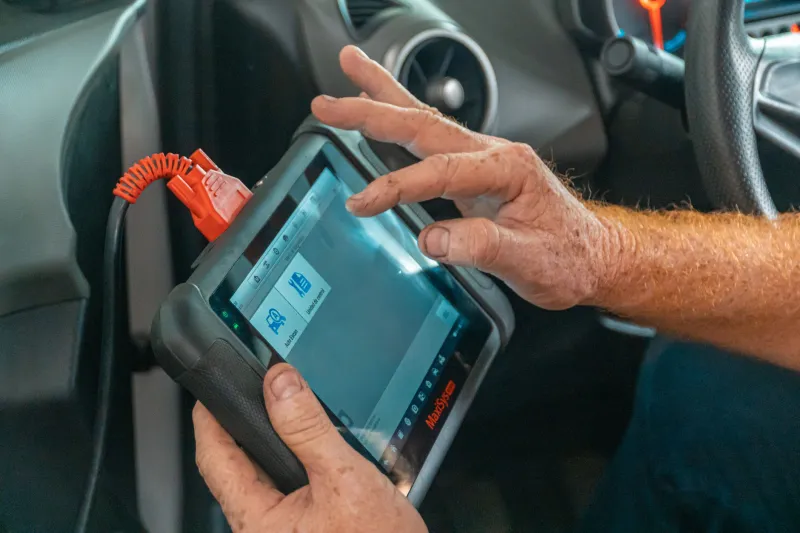
For sealed transmissions, verifying fluid level requires either a manufacturer-specific procedure or diagnostic equipment capable of reading transmission temperature in real time. Most procedures involve warming the transmission to a specific operating temperature, locating a fill or check plug on the transmission case, and verifying that fluid is present at the correct level before reinstalling the plug.
This is not a procedure that can be performed with consumer-grade tools in a home garage. It requires a lift, the correct plug tools, and in many cases, a scan tool to confirm that temperature parameters are met during the check. The labor involved is modest when performed as part of a scheduled service, but it is not free—and it cannot be replicated by the driver alone.
The practical implication is that owners of sealed-transmission vehicles are dependent on professional service intervals to maintain visibility into their transmission's fluid condition. Skipping those intervals does not mean nothing is happening inside the transmission. It means no one is watching while it happens.
Protecting a Component You Can't See
The sealed transmission represents a genuine engineering advancement paired with a genuine maintenance communication failure. Drivers were told their transmissions required less attention without being told what "less" actually means in practice—or what the consequences of misunderstanding that term would be.
The appropriate response is not frustration with the design. It is a disciplined service schedule that accounts for the limitations of sealed access. A qualified transmission specialist can perform fluid condition checks using color and odor assessment of extracted samples, even when a dipstick is absent. Thermal imaging and scan tool data can reveal early signs of stress before mechanical symptoms appear.
The transmission in your vehicle may be sealed. Your maintenance schedule should not be.