One Belt, Eleven Consequences: What Happens When Your Serpentine Belt Finally Gives Out
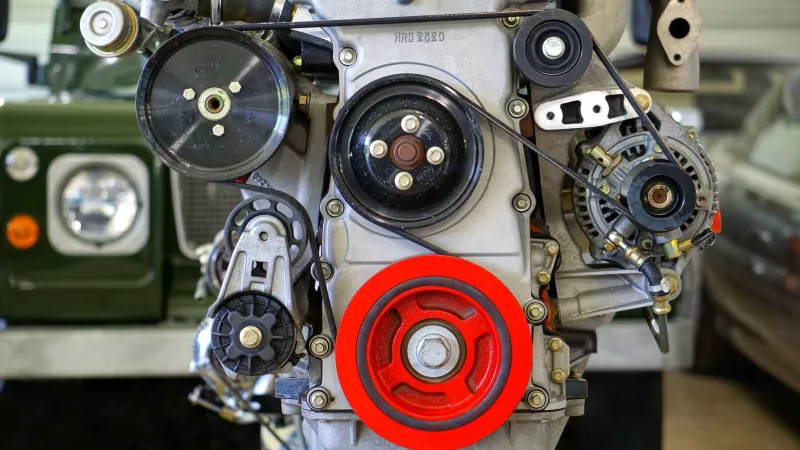
There is a single rubber loop running across the front of your engine right now. It is roughly the width of your thumb, ribbed on one side, and spinning at thousands of revolutions per minute every time you drive. It powers your alternator, your power steering pump, your air conditioning compressor, your water pump, and in many vehicles, additional accessories beyond that. It does all of this without a warning light, without a maintenance reminder in most owner's manuals, and without any fanfare whatsoever.
That belt is called the serpentine belt. And when it fails — not if — the consequences are rarely limited to just the belt itself.
What the Serpentine Belt Actually Does
Unlike older vehicles that used multiple individual belts to drive specific accessories, modern cars consolidate this function into one continuous loop: the serpentine belt. The name comes from the way it winds and snakes around a series of pulleys throughout the engine bay.
At any given moment, that belt may be simultaneously driving:
- The alternator, which charges your battery and powers your electrical systems while the engine runs
- The power steering pump, which makes steering feel manageable at low speeds
- The air conditioning compressor, which keeps your cabin comfortable
- The water pump, which circulates coolant through the engine to prevent overheating
- The smog pump and other emissions-related components, depending on the vehicle
When a serpentine belt snaps, all of those systems lose their power source simultaneously. Your steering becomes heavy and difficult. Your battery begins draining within minutes because the alternator is no longer charging it. If your water pump is belt-driven, your engine temperature begins climbing almost immediately. You have, at that point, a very narrow window before the situation escalates from inconvenient to genuinely damaging.
Why Most Drivers Have No Idea When to Replace It
Unlike brake pads, which give you a squealing warning, or engine oil, which has a well-publicized mileage interval, the serpentine belt operates in relative obscurity. Many vehicle owner's manuals are vague about replacement intervals, and because the belt is designed to look and feel intact right up until the point of failure, visual inspections are often misleading.
The material itself — typically EPDM rubber — has evolved significantly over the past two decades. Earlier serpentine belts made from neoprene would visibly crack and fray as they aged, giving drivers and mechanics a reliable visual cue. Modern EPDM belts, however, wear from the inside out. The ribbed surface that contacts the pulleys gradually loses material in a process called groove wear, but the outer surface of the belt can appear perfectly normal to the untrained eye.
This is precisely why so many serpentine belts fail without warning. The belt looks fine. It sounds fine. And then, often at the worst possible moment — on the highway, in traffic, in a summer heat wave — it doesn't.
The Warning Signs That Precede Failure
While sudden failure is possible, most serpentine belts do telegraph distress before they snap entirely. The problem is that these signals are easy to dismiss or misattribute to other causes.
Squealing or chirping noises are among the most common early indicators. These sounds typically emerge when the belt slips on a pulley — often due to wear, contamination from an oil leak, or a failing tensioner that can no longer maintain proper belt tension. Many drivers assume this is a minor nuisance and continue driving. It is not a minor nuisance.
Visible cracking or glazing on the belt surface, while less reliable on modern EPDM belts, is still worth noting. A glazed, shiny appearance on the ribbed side suggests the belt has been slipping and overheating.
Accessory performance degradation is another signal that often goes unrecognized. If your power steering feels slightly heavier than usual, if your battery warning light flickers briefly, or if your air conditioning output seems inconsistent, a slipping or weakening serpentine belt may be the underlying cause.
The tensioner and idler pulleys deserve equal attention. The tensioner is the spring-loaded pulley that keeps constant pressure on the belt. When the tensioner weakens or the pulley bearing begins to fail, belt slippage and premature wear follow. A mechanic inspecting your serpentine belt should always evaluate the tensioner and idler pulleys at the same time — replacing the belt without addressing a failing tensioner is a short-term fix at best.
When a $100 Part Becomes a $1,000 Problem
The math on serpentine belt neglect is straightforward and unpleasant.
A serpentine belt replacement, when performed proactively as routine maintenance, typically costs between $75 and $200 at a reputable shop, depending on the vehicle and whether the tensioner is replaced simultaneously — which it generally should be.
A serpentine belt failure on the road, however, initiates a cascade. If the belt snaps while you are driving and your water pump is belt-driven, your engine may overheat before you can safely pull over. Overheating can warp cylinder heads, damage head gaskets, or in severe cases cause catastrophic internal engine damage. Head gasket replacement alone commonly runs $1,500 to $2,500. Engine replacement can reach $4,000 or more depending on the vehicle.
Beyond the engine itself, a dead alternator, a damaged power steering pump, or a seized AC compressor — all potentially caused by the sudden loss of the belt — can add hundreds of dollars each to the repair total. A tow truck, a rental car, and lost time round out the financial picture.
This is the fundamental paradox of serpentine belt neglect: the repair is inexpensive precisely because the component is simple. Waiting until it fails makes it expensive because of everything it takes down with it.
What a Responsible Replacement Interval Looks Like
As a general guideline, most manufacturers recommend serpentine belt inspection every 60,000 miles and replacement somewhere between 60,000 and 100,000 miles. However, these figures vary by manufacturer and driving conditions. Vehicles that operate frequently in extreme heat, that accumulate a lot of short-trip miles, or that have any history of oil leaks near the belt area may experience accelerated wear.
The most reliable approach is to have the belt evaluated by a qualified technician at each major service interval — not just visually, but with proper inspection tools that can measure rib depth and assess tensioner function. At Carshen Garage, this type of inspection is part of how we approach every vehicle that comes through our doors, because we understand that the components most likely to be overlooked are often the ones most capable of causing serious damage.
The Takeaway
Your serpentine belt is not a dramatic component. It does not announce itself. It does not have a sensor dedicated to monitoring its condition. It simply works — until it doesn't.
That quiet reliability is precisely what makes it dangerous to ignore. Replacing a serpentine belt on schedule is one of the most cost-effective maintenance decisions a driver can make. It is a small investment in a component that, if neglected, has the capacity to strand you on the side of the road and initiate repairs that cost ten to twenty times what the belt itself would have.
Schedule an inspection. Know your mileage. Do not wait for the squeal to become a snap.