When Steady Means Nothing: The Thermostat Failure Your Temperature Gauge Will Never Show You
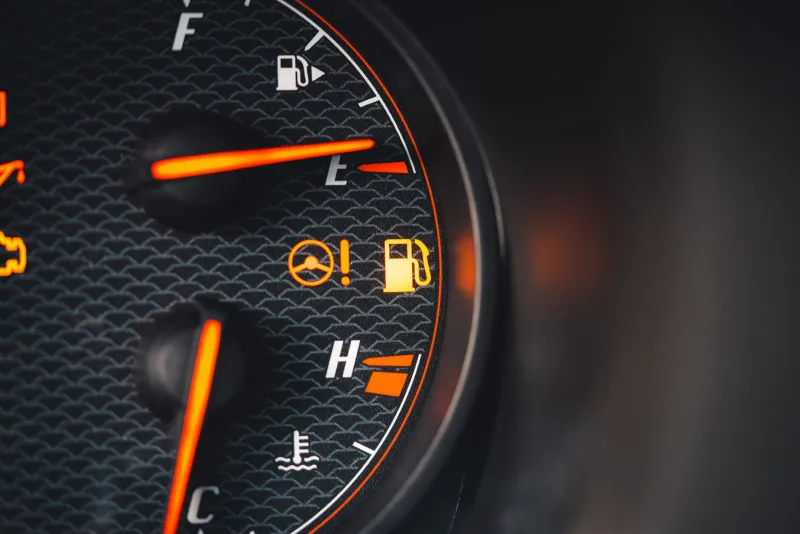
There is a particular kind of automotive failure that is difficult to guard against — not because it is rare or complex, but because it looks perfectly normal right up until it isn't. The thermostat is precisely that kind of failure. At roughly $20 to $50 for the part itself, it ranks among the least expensive components in your entire cooling system. Yet when it begins to malfunction, the consequences can cascade into engine damage that runs well into the thousands of dollars. What makes this especially frustrating is that your temperature gauge, the instrument you rely on most to assess engine health at a glance, is often the last thing to signal that anything is wrong.
What a Thermostat Actually Does
Most drivers understand the thermostat in the broadest terms: it regulates engine temperature. But the mechanism behind that regulation matters more than the summary suggests. The thermostat is a thermally activated valve positioned between the engine block and the radiator. When your engine is cold, the thermostat remains closed, allowing coolant to circulate only within the engine itself. This restricted loop enables the engine to reach its optimal operating temperature quickly — typically between 195°F and 220°F depending on the vehicle — which improves fuel efficiency, reduces emissions, and minimizes internal wear.
Once the engine reaches that target range, the thermostat opens and allows coolant to flow through the radiator, where heat is dissipated before the cooled fluid returns to the engine. This open-and-close cycle repeats continuously, maintaining a precise thermal balance. It is a simple process, but the precision it requires is anything but trivial.
The Two Ways a Thermostat Can Fail — And Why One Is Far More Dangerous
Thermostats fail in one of two ways: they stick open or they stick closed. A thermostat that sticks closed is the failure most drivers fear, and for good reason. Coolant stops flowing to the radiator, temperatures climb rapidly, and the gauge needle moves decisively toward the red zone. The warning is obvious. You pull over. You avoid catastrophe — or at least you have the opportunity to.
A thermostat that sticks open is a different problem entirely. When the valve remains permanently open, coolant flows continuously through the radiator regardless of engine temperature. The engine never fully reaches its optimal operating range, or it reaches it inconsistently. Combustion efficiency drops. Fuel consumption rises. Emissions worsen. Internal components experience the kind of chronic thermal stress that accelerates wear over months and years rather than minutes.
Here is where the deception enters. Because the coolant is always flowing and always being cooled, the temperature gauge often reads within a normal range. From the driver's seat, everything appears fine. The needle sits where it always has. There is no alarm, no warning light, no obvious symptom demanding attention. The engine, however, is paying a quiet and ongoing price.
Why Modern Thermostats Fail Differently
Older thermostats were simple mechanical devices — a wax pellet inside a brass housing that expanded and contracted with heat. They were durable, predictable, and relatively easy to diagnose because their failures tended to be dramatic. Contemporary thermostats, particularly those found in vehicles manufactured over the last fifteen years, are considerably more sophisticated. Many are electronically controlled, integrated with the engine management system, and capable of variable operation based on driving conditions and load.
This added complexity introduces new failure modes. An electronically controlled thermostat can fail in ways that produce no mechanical symptoms at all. The wax element may degrade gradually rather than abruptly, causing inconsistent valve behavior that a temperature gauge simply cannot track with sufficient precision. In some cases, the thermostat housing — often made from plastic in modern vehicles to reduce weight — cracks or warps before the thermostat itself fails, creating slow coolant leaks that further complicate diagnosis.
OBD-II systems on most post-1996 vehicles do monitor coolant temperature, and some will generate a fault code if the engine takes too long to reach operating temperature. But this detection is not universal, and the threshold for triggering a code is often set wide enough that a partially compromised thermostat never crosses it.
The Warning Signs That Appear Before the Gauge Moves
Because the temperature gauge is an unreliable early indicator of thermostat trouble, drivers need to watch for subtler signals. Several patterns consistently precede gauge-level distress.
Heater performance that disappoints. If your cabin heater takes noticeably longer to produce warm air than it once did, or if it produces only lukewarm output even after extended driving, the engine may not be reaching full operating temperature. A stuck-open thermostat is a common culprit.
Fuel economy that quietly declines. Engines operating below their thermal optimum consume more fuel. If your miles per gallon have trended downward without a change in driving habits, traffic patterns, or tire pressure, thermal inefficiency is worth investigating.
Temperature gauge behavior that seems inconsistent. A healthy thermostat holds the engine in a narrow temperature band. If your gauge needle drifts lower than usual during highway driving, climbs slightly in stop-and-go traffic, or takes longer than normal to settle after a cold start, the thermostat's regulatory function may be compromised.
White exhaust vapor that lingers. In cold weather, some condensation from the exhaust is normal. But persistent white vapor after the engine has fully warmed, or a sweet smell accompanying that vapor, may indicate coolant entering the combustion chamber — a condition sometimes associated with thermal irregularities caused by thermostat failure.
The Diagnostic Gap That Catches Drivers Off Guard
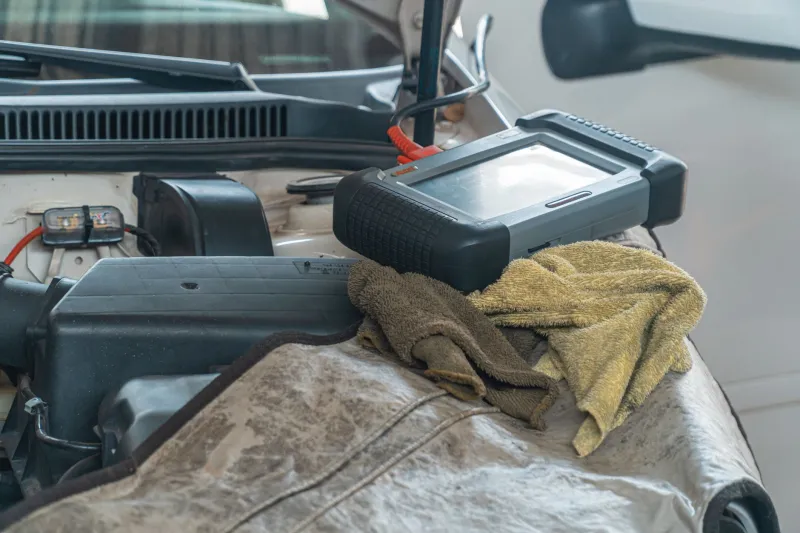
Part of what makes thermostat diagnosis difficult is that a basic OBD-II scan often returns no codes at all when the thermostat is the problem. The engine is technically running. The coolant temperature sensor is reading a value. Nothing has crossed a programmatic threshold. A scanner reports clean results, and a driver walks away with a false sense of reassurance.
Proper thermostat evaluation requires a technician to monitor coolant temperature data in real time — observing how quickly the engine reaches operating temperature, how consistently it holds that temperature under varying loads, and whether the temperature behavior matches manufacturer specifications. This is the kind of diagnostic work that goes beyond code retrieval and requires actual mechanical interpretation.
A $50 Part, a $5,000 Lesson
The repair cost for a thermostat itself is modest. Even with labor factored in, most thermostat replacements fall well under $300 at a reputable shop. The cost of ignoring a failing thermostat, however, is measured in a different currency entirely. Chronic overheating — even mild, intermittent overheating that never fully registers on the gauge — accelerates head gasket wear, warps cylinder heads, and degrades engine seals. These are repairs that routinely exceed $2,000 and can approach the value of the vehicle itself in older models.
The thermostat's reliability as a component is part of what makes its failure so easy to overlook. Most drivers never replace one proactively. Many never think about it at all. But given what it protects and what it costs to replace, treating it as a maintenance item rather than a failure-only concern is a straightforward way to preserve both your engine and your budget.
If your heater seems less effective than it should be, your fuel economy has drifted without explanation, or your temperature gauge behavior has changed in any way, bring those observations to a qualified technician. The gauge may be telling you everything is fine. The thermostat may have an entirely different story to tell.